
The KPI Library
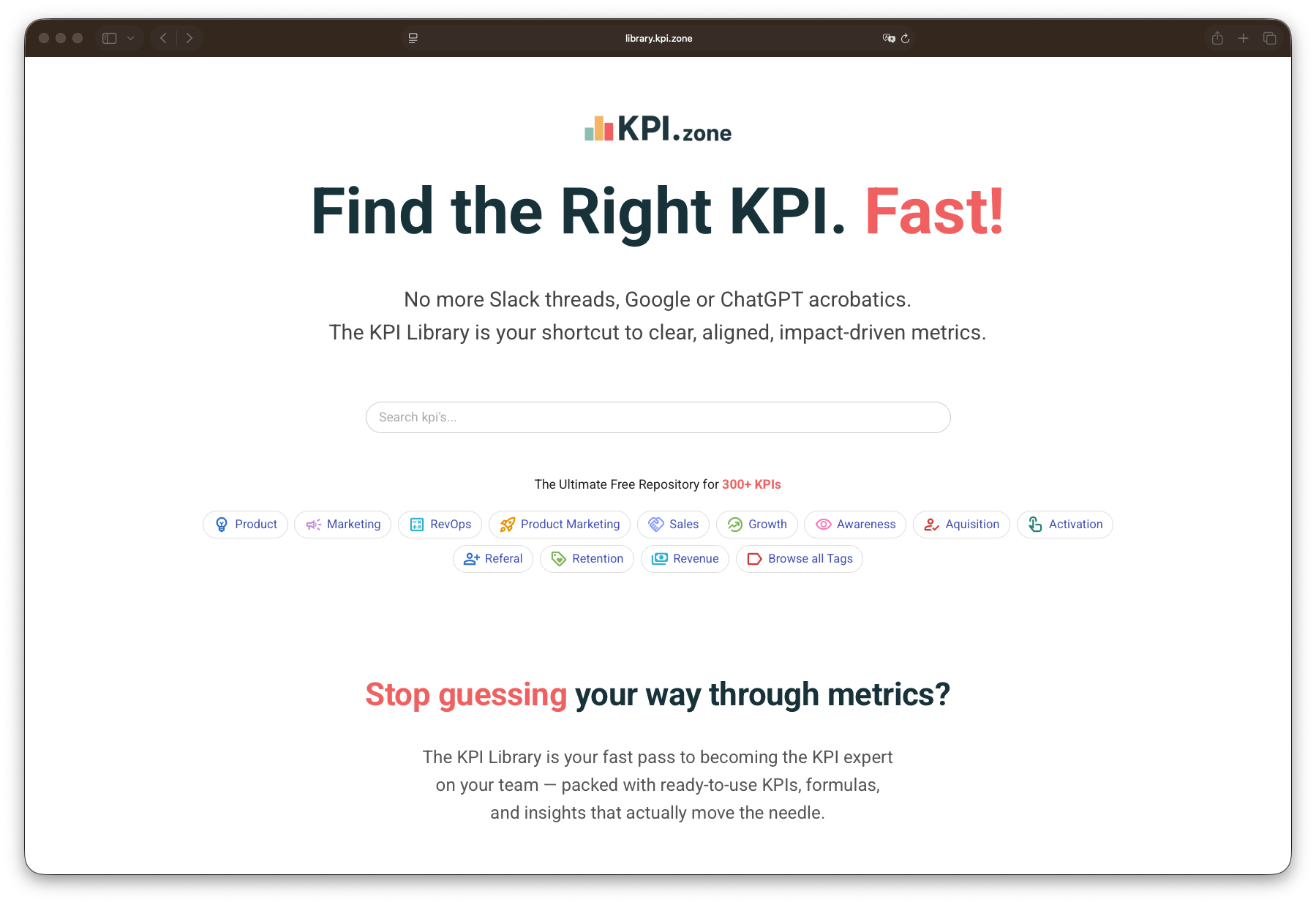
Most teams don’t struggle with data. They struggle with understanding it. KPI literacy means knowing what a metric measures, why it matters, and how to act on it. The KPI Library helps teams align on 300+ KPIs with clear definitions, context, and practical guidance for better decisions.

Why knowing your metrics is a skill, not a shortcut
Most teams don't struggle to measure things. They struggle to measure the right things — and to understand what those numbers are actually telling them.
That gap is rarely about data access. It's about KPI literacy: knowing what a metric measures, why it matters in context, how it connects to the decisions your team is trying to make, and what you'd actually do differently based on what it shows.
The KPI Library exists to help you build that literacy.
What KPI literacy actually means
Knowing a KPI's name isn't the same as understanding it. Real KPI literacy means knowing:
- What a metric actually measures — and what it doesn't
- Where it belongs in your funnel or business model
- What inputs drive it, and which direction
- How it connects to the metrics around it
- Who owns it, and what "improving it" would actually require
Most teams are weak on all five. That's not a criticism — it's just not something anyone explicitly teaches. This library is an attempt to fix that.
What's in the library
300+ KPIs across areas including Product Marketing, Product Management, Revenue Operations, and more. Each entry is built for learning, not just lookup:
Clear definitions — No more debating what "activation" or "adoption" actually means. Each KPI is defined precisely, so your team can align on what you're measuring before you measure it.
Formulas and data inputs — The exact calculation, not a vague description. Because a metric you can't calculate consistently isn't a metric — it's a conversation.
Business and funnel context — Where does this KPI live? What stage of the AAARRR funnel does it belong to? What strategic goal does it serve? Context turns a number into a signal.
Related metrics — KPIs don't operate in isolation. Understanding what sits upstream and downstream of a metric is often more valuable than the metric itself.
What moves it — The inputs, levers, and tactics that actually shift the needle. Not theory — practical starting points for improvement.
Suggested ownership — Every KPI has a suggested owner. Because a metric without an owner is just noise on a dashboard.


How to use it
If you're building a measurement system, start by exploring the categories relevant to your work. Don't just collect KPIs — read the context, the related metrics, the drivers. You're looking for the 4-6 metrics that genuinely reflect how your part of the business works. The library helps you see the full landscape before you narrow your focus.
If you're new to a metric, look it up and sit with it. Read the definition carefully. Ask yourself: do we actually measure this the way it's defined? what would change if we did? That gap between what you think you're measuring and what you're actually measuring is where most team misalignments live.
If you're more experienced, use it as a calibration tool. You'll find metrics you've used for years defined more sharply, calculated more precisely, or connected to adjacent KPIs you hadn't considered. Small refinements in how you think about a metric can meaningfully change how you act on it.
If you're aligning a team, the definitions alone are worth the visit. Half of most measurement debates aren't about strategy — they're about people using the same word to mean different things.


What the library won't do
It won't tell you which KPIs to pick. That depends on your strategy, your stage, your team, and what you're actually trying to learn. If you want help with that, start with the articles on building your measurement system or choosing the right KPI framework or reach out. I'm always happy to help.
Have fun!
The KPI Library is free to use. If you find it valuable, a mention or backlink is always appreciated. And if you have a KPI to add, refine, or challenge — contributions are welcome. Good measurement is a collective practice.