Shared KPIs Beat Status Meetings: The Leadership Alignment Upgrade You Need
Sick of endless status meetings? Align your leadership team with shared KPIs, cut the noise, and drive faster, smarter decisions through real-time dashboards and async updates. Upgrade how your team collaborates — and scales — for good.
We were two minutes into our weekly exec sync, and already it had begun.
"What’s the latest on sales qualified leads?"
"Wait—are we using your spreadsheet or the new dashboard?"
"Didn’t marketing say MQLs were up?"
I sat there watching the same old story unfold: different numbers, different formats, different stories. The update meeting had turned into a debate about data integrity instead of strategy. Again.
And here’s the thing: every single person in that room cared. But we were wasting our collective brainpower just trying to sync facts.
So we tried something different. We killed the weekly update call. And we built a shared KPI dashboard instead.
KPIs Aren’t Just Metrics. They’re Alignment Tools.
Most teams treat KPIs like scoreboards. But what if I told you they’re better used as compasses?
The right KPIs tell your team not just how they’re doing but whether everyone’s going in the same direction. They’re strategic alignment tools, not just performance trackers.
Done well, they:
Make your priorities unmissable
Give teams real-time feedback on what’s working
Replace guesswork with clarity
But when KPIs are siloed or misaligned, it’s like everyone's rowing in a different direction.
Busy? Sure. Productive? Not even close.
Shared KPIs give leadership teams a common language. They let marketing, sales, product, and ops all see how their efforts stack up toward the same outcomes.
When KPIs align, meetings become about what to do, not what’s going on.
Why We Ditched the Update Meetings (And You Should Too)
Meetings aren’t evil. But they’re often overused.
A 2023 Atlassian survey of 5,000 knowledge workers found:
72% of meetings are viewed as ineffective
78% say too many meetings hurt their actual work
We saw it ourselves. Endless update meetings were burning hours each week.
The result? Low energy. Minimal decisions. Tons of repetition.
So we ran a test: what if we shifted to shared dashboards + async updates?
Here’s what we did:
Built a live KPI dashboard visible to all leaders.
Replaced weekly syncs with a "3-Minute Monday" update: one Zoom call, plus links to the dashboard.
Reserved meetings only for decision-making and roadblock removal.
The result? A 40% drop in meeting hours and a massive jump in meeting quality.
People came in informed. And instead of debating numbers, we tackled strategy.
Your KPIs Should Work Harder Than Your Calendar
If you're relying on meetings to align your leadership team, you're solving the wrong problem.
Visibility shouldn’t require a Zoom link.
Shared KPI dashboards let everyone:
See the same data, in the same format
Track progress in real-time
Spot issues early and discuss insights, not raw metrics
And when people have access to the same source of truth, alignment stops depending on meetings and starts depending on momentum.
Four Frameworks That Turn KPIs Into Alignment Machines
Looking for structure? These are the four frameworks we’ve seen work wonders for teams scaling fast.
1. The 4 Disciplines of Execution (4DX)
Focus on a few Wildly Important Goals (WIGs)
Define lead & lag KPIs for each goal
Use a visible scoreboard everyone understands
Hold short weekly check-ins to update the score and commit to next steps
If your scoreboard doesn’t answer that in 5 seconds, it’s not working hard enough.
2. North Star Metrics (NSM)
Every team needs a shared north. One metric that represents the core value you deliver.
Facebook? Monthly Active Users. Amazon? Customer Lifetime Value.
Pick yours. Make it visible. Make it count.
A good NSM is:
Aligned to your mission
Cross-functional in impact
Measurable over time
3. Lean Analytics (One Metric That Matters)
Sometimes, you need radical focus.
Lean Analytics introduces the OMTM: One Metric That Matters.
It’s the only metric you care about more than anything else at a given time.
This isn't forever. But it forces clarity. At any moment, the entire team should know:
What’s the #1 thing we’re trying to improve?
Are we winning?
When priorities change, so does the OMTM. But never track 10 things when one matters most.
4. OKRs (Objectives and Key Results)
The classic.
Set bold, qualitative Objectives
Define 2–5 Key Results per objective (quantitative)
Track progress openly and regularly
When done well, OKRs:
Translate strategy into measurable targets
Align cross-functional teams
Replace guesswork with clarity
The best part? Shared visibility.
No one has to ask, "Are we on track?" — The dashboard already answered.
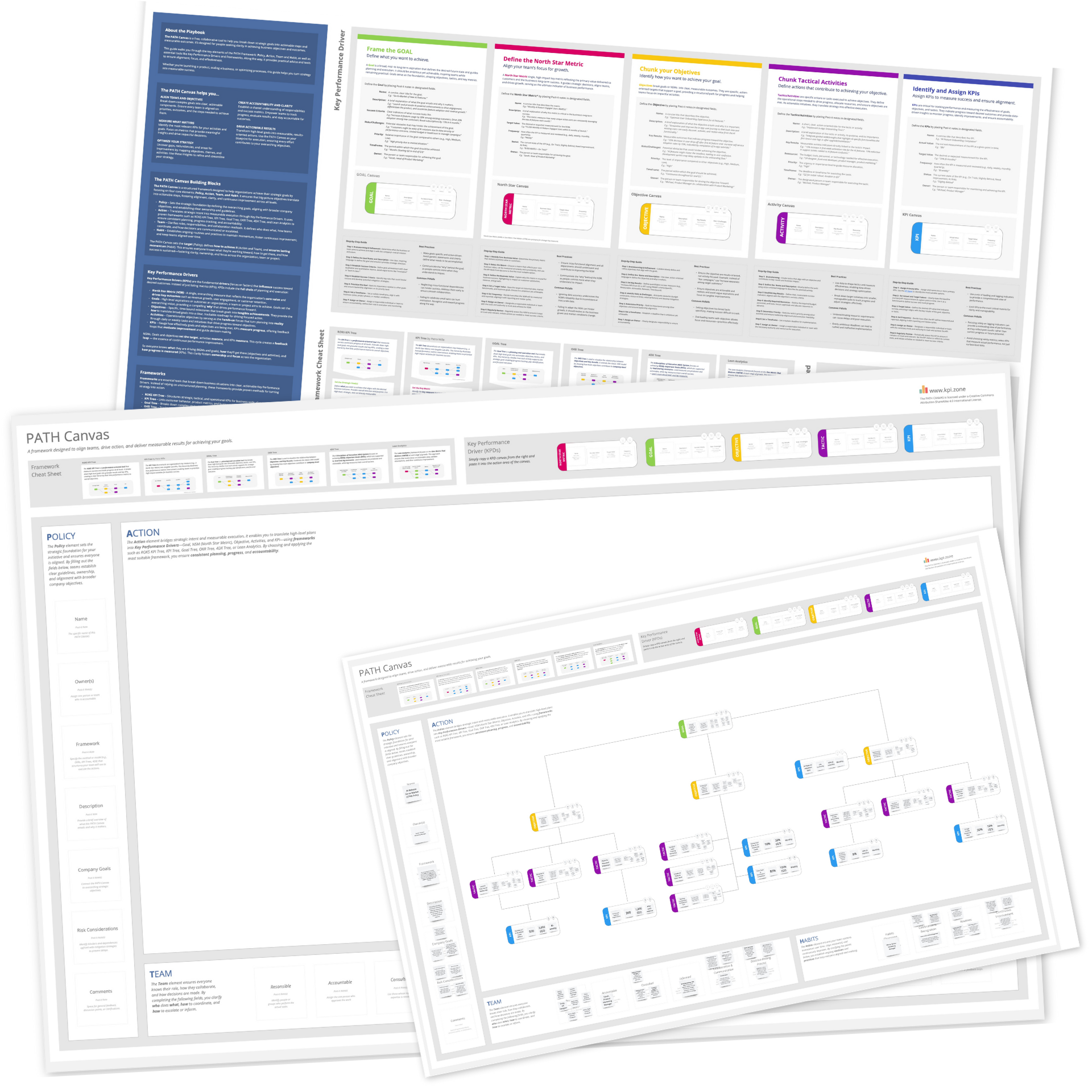
You can build and visualise your KPIs using my Path Canvas. It’s a great way to define, align, and map metrics across teams — before you ever open a spreadsheet. Plus, you'll get a detailed playbook on how to navigate different frameworks as a bonus.