The PATH Canvas: When Every Team Builds Their KPI System Differently
PATH Canvas is a blueprint-based KPI design system that unifies teams through shared terminology, frameworks, and structured collaboration. It standardizes key components like North Star Metrics, Goals, and KPIs, enabling scalable, connected performance systems across organizations.


Product Googles "how to create OKRs" and finds a template. Marketing asks ChatGPT for KPI best practices and gets different advice. Operations downloads a dashboard framework from a blog post. Each team does the work. But they've learned different methods, use different terminology, and built systems that can't connect.
This isn't a problem of bad metrics or lazy teams. It's a problem of no shared design system for building KPI frameworks.
The Real Problem: No Blueprint for KPI Design
When teams need to create a KPI system, they start from scratch:
- They search for best practices and find dozens of conflicting approaches
- They ask AI for guidance and get different frameworks each time
- They download templates that use different structures and terminology
- They build something that works for them—but only for them
The result? Every team creates their own interpretation. Product's "Objectives" mean something different than Marketing's "Objectives." Operations structures their KPIs in ways that don't map to anyone else's system. Different levels of depth. Different levels of understanding. Different design choices.
It's like every team inventing their own language while trying to have a conversation.
What's missing isn't better frameworks—it's a shared design system that teaches teams how to build KPI systems the same way, using the same building blocks, following the same blueprint.
PATH Canvas: A Design System for KPIs
PATH Canvas is a blueprint and a standardized way to design and build KPI systems regardless of which methodology you choose.
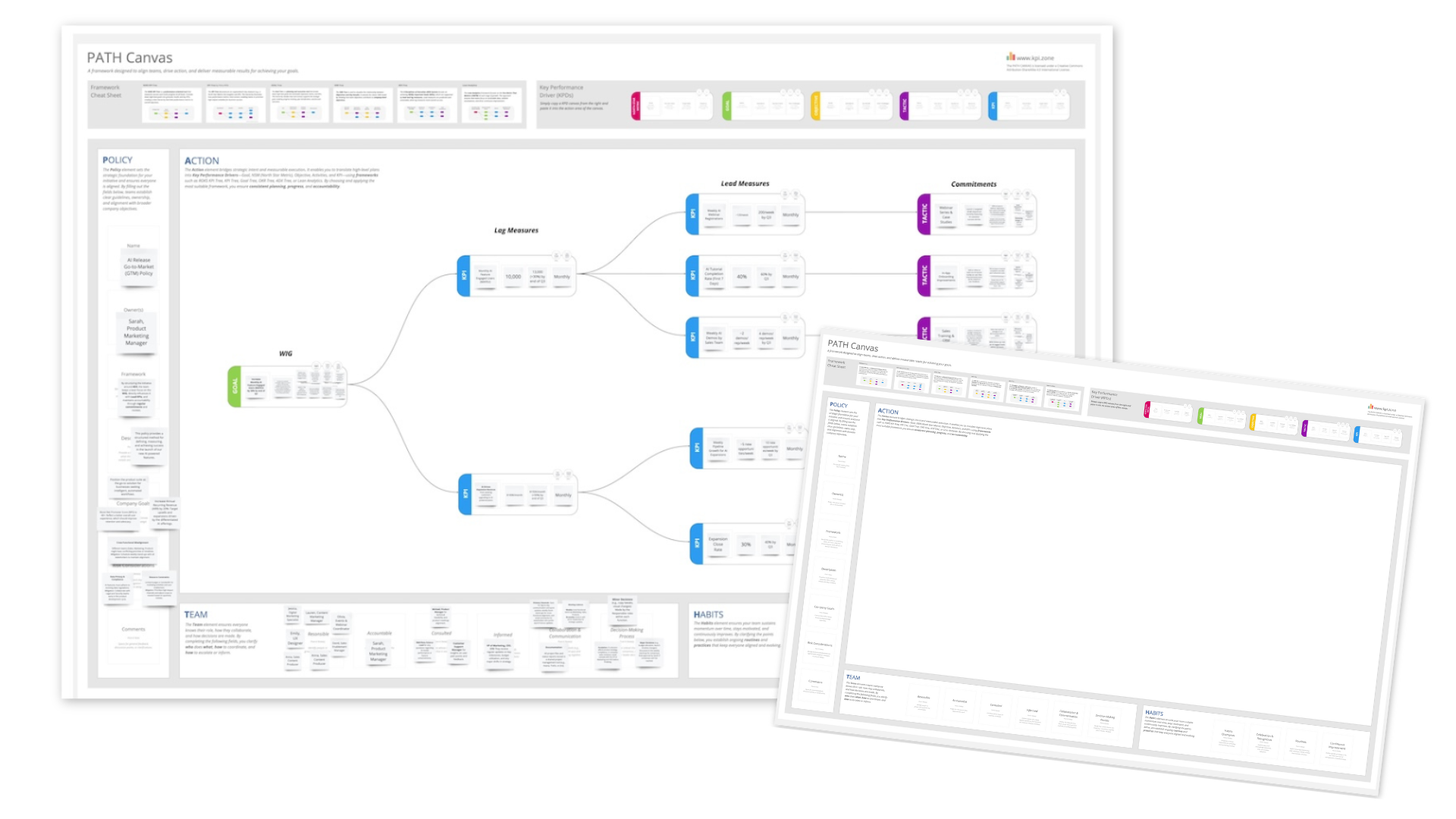
Think of it like a design system in software (Material Design, Apple's HIG). It provides:
- Common components everyone uses the same way
- Shared vocabulary so teams speak the same language
- Structured patterns showing how to arrange components
- Clear guidelines for different use cases
When Product builds an OKR system and Marketing builds a campaign tracking system using PATH Canvas, they're both using the same building blocks (North Star Metric, Goals, Objectives, Activities, KPIs), arranging them within the same structure (Policy, Action, Team, Habit), following the same design principles.
The systems they build are different, but they're compatible. They can connect. They speak the same language.
It has three core elements:
1. Standardized Building Blocks (Key Performance Drivers)
Every KPI system, regardless of framework, is built from the same five components:
North Star Metric— The single measure reflecting your core business value (revenue growth, user engagement, customer retention)
Goals — High-level outcomes you're driving toward. Goals set the vision and provide the compelling "why" that drives performance.
Objectives — Specific, time-bound milestones that break goals into tangible achievements. They translate broad goals into a clear, trackable roadmap.
Activities — Tactical work that operationalizes objectives. The hands-on initiatives that turn planning into reality through daily or weekly tasks.
KPIs — Metrics that gauge how effectively goals and objectives are being met. They measure progress and provide feedback loops for improvement.
These Key Performance Drivers (KPDs) create consistency. Whether you're building an OKR Tree or a Goal Tree, you use these same blocks with these same definitions. This makes systems interoperable—Product's objectives can link to Marketing's activities because they're using the same component library.
2. The PATH Structure: Four Dimensions That Make KPIs Work
KPIs don't work in isolation. A number on a dashboard doesn't drive action. KPIs need to be embedded in a system with four dimensions:
Policy — Sets the strategic foundation. What goal are we achieving? Who owns it? How does it align with company objectives? What are the constraints and guidelines? Policy provides the context that connects KPIs to strategy.
Action — Translates strategy into measurable execution. This is where your chosen framework lives—where you arrange your KPDs (North Star Metric, Goals, Objectives, Activities, KPIs) using proven methodologies like OKR Trees, Goal Trees, 4DX, or Lean Analytics. Action provides the execution plan.
Team — Clarifies roles and accountability. Who's responsible for each KPI? Who's accountable when it moves? Who needs to be consulted or informed? How do teams coordinate? How are decisions made and escalated? Team provides the ownership structure.
Habit — Establishes routines for continuous improvement. How often do you review KPIs? What triggers action when metrics go off-track? How do you iterate based on results? Habit builds a KPI-driven culture through regular reviews, impact assessments, and strategic adjustments.
This is what transforms a KPI dashboard into a performance management system. The measurement is embedded in governance (Policy), execution (Action), accountability (Team), and continuous improvement (Habit).
3. Framework Selection Based on Your Challenge
PATH Canvas includes six proven frameworks. Each solves a different problem:
ROKS KPI Tree — Structures strategic, tactical, and operational KPIs for business-wide alignment across all levels of the organization.
KPI Tree — Links customer behavior to product metrics to business impact, showing how user actions drive outcomes.
Goal Tree — Breaks down complex strategic objectives into actionable steps using the Theory of Constraints methodology.
OKR Tree — Tracks quarterly performance and aligns individual or team goals, cascading objectives across the organization.
4DX Tree — Focuses on execution and accountability for mission-critical objectives using lead measures and lag measures.
Lean Analytics — Applies data-driven iteration and experimentation to validate hypotheses and optimize products or business strategies.
The canvas helps you choose which framework fits your current challenge—then build it using the standardized KPD blocks within the PATH structure. Different frameworks, same components, same system dimensions.
How It Works: A Product Launch
Here's how a product team uses PATH Canvas to launch AI features:
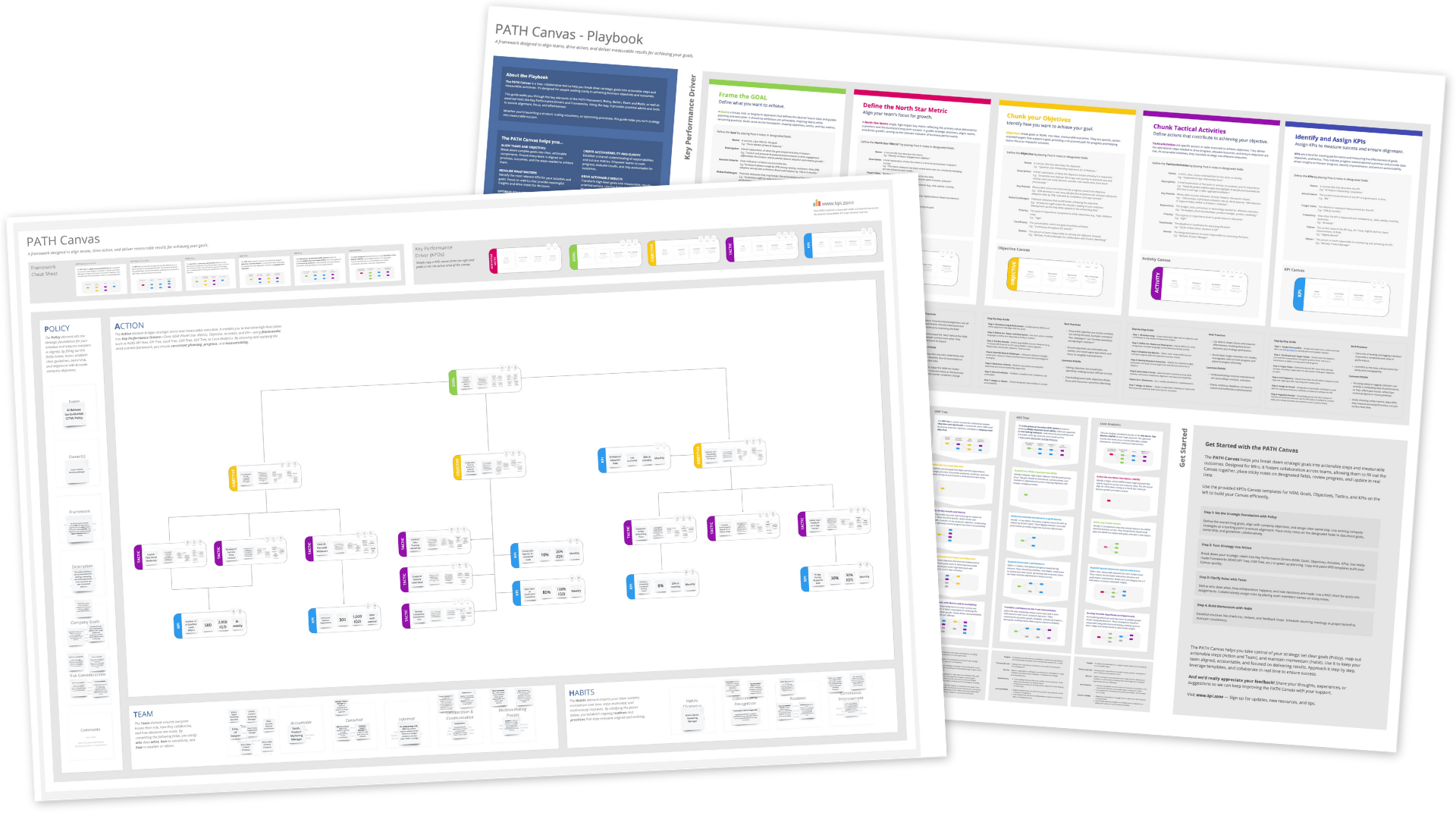
Policy Quadrant:
Strategic Goal: Launch AI features to increase revenue by 15% in 6 months
Owner: Head of Product Marketing
Alignment: Supports company objective to drive product differentiation
Guidelines: Must maintain data privacy standards, budget cap of $200K
Action Quadrant:
Framework Selected: Goal Tree (complex initiative requiring breakdown)
North Star Metric: Monthly AI Feature Engaged Users (MAFEU)
Target: 15,000 MAFEU within 6 months
The team uses KPD cards to build the tree:
- Goal Card: "Increase trial-to-paid conversion for AI features from 2.3% to 4.5%"
- Objective Card: "Optimize onboarding experience" (Key Result: 25% reduction in user drop-off)
- Activity Card: "Implement in-app guided tours" (Resources: UX designer, front-end developer)
- KPI Card: "First-week activation rate" (Current: 8%, Target: 20%)
Each card has designated fields—name, description, success criteria, timeframe, owner. The visual tree shows how activities drive objectives, objectives drive goals, and goals drive the North Star Metric.
Team Quadrant:
RACI Chart populated:
- North Star Metric Owner: Sarah (Head of Product Marketing) - Accountable
- Objective Owner: Michael (Product Manager) - Responsible
- Activity Execution: UX Designer (Responsible), Front-end Developer (Responsible)
- Stakeholders: Engineering Lead (Consulted), Customer Success (Informed)
Collaboration Method: Weekly sync meetings, Slack channel for daily coordination
Escalation Path: Product Manager → Head of Product Marketing → VP Product
Habit Quadrant:
Weekly: Review KPI status in Monday stand-ups, identify blockers
Bi-weekly: Assess if activities are moving objectives forward, adjust tactics if needed
Monthly: Evaluate if objectives are driving goals, review North Star Metric progress
Quarterly: Challenge if goals still align with North Star Metric, iterate strategy
The entire team works in the same canvas. Marketing sees how their campaign activities connect to Product's activation objectives. Product sees how their work drives the North Star Metric. Leadership sees the full picture—all using the same vocabulary, same structure, same building blocks.
Three Problems This Solves
Problem 1: Incompatible Systems
When every team builds their KPI system differently, the systems can't connect. Product's "Key Results" don't map to Marketing's "Campaign Targets." PATH Canvas gives everyone the same building blocks and structure, making systems compatible by design.
Problem 2: Lost Strategic Context
Teams track KPIs without understanding how they connect to strategy. A KPI dashboard shows numbers, but not why those numbers matter. PATH Canvas embeds every KPI in the Policy dimension (what strategic goal does this support?) and Action dimension (what's the causal chain?).
Problem 3: No Accountability or Improvement
KPIs get measured but not managed. Nobody owns them. Nobody reviews them regularly. Nobody iterates based on results. PATH Canvas makes ownership explicit (Team dimension) and builds improvement routines (Habit dimension).
Learning the Design System
PATH Canvas works like any design system—it's learnable and repeatable.
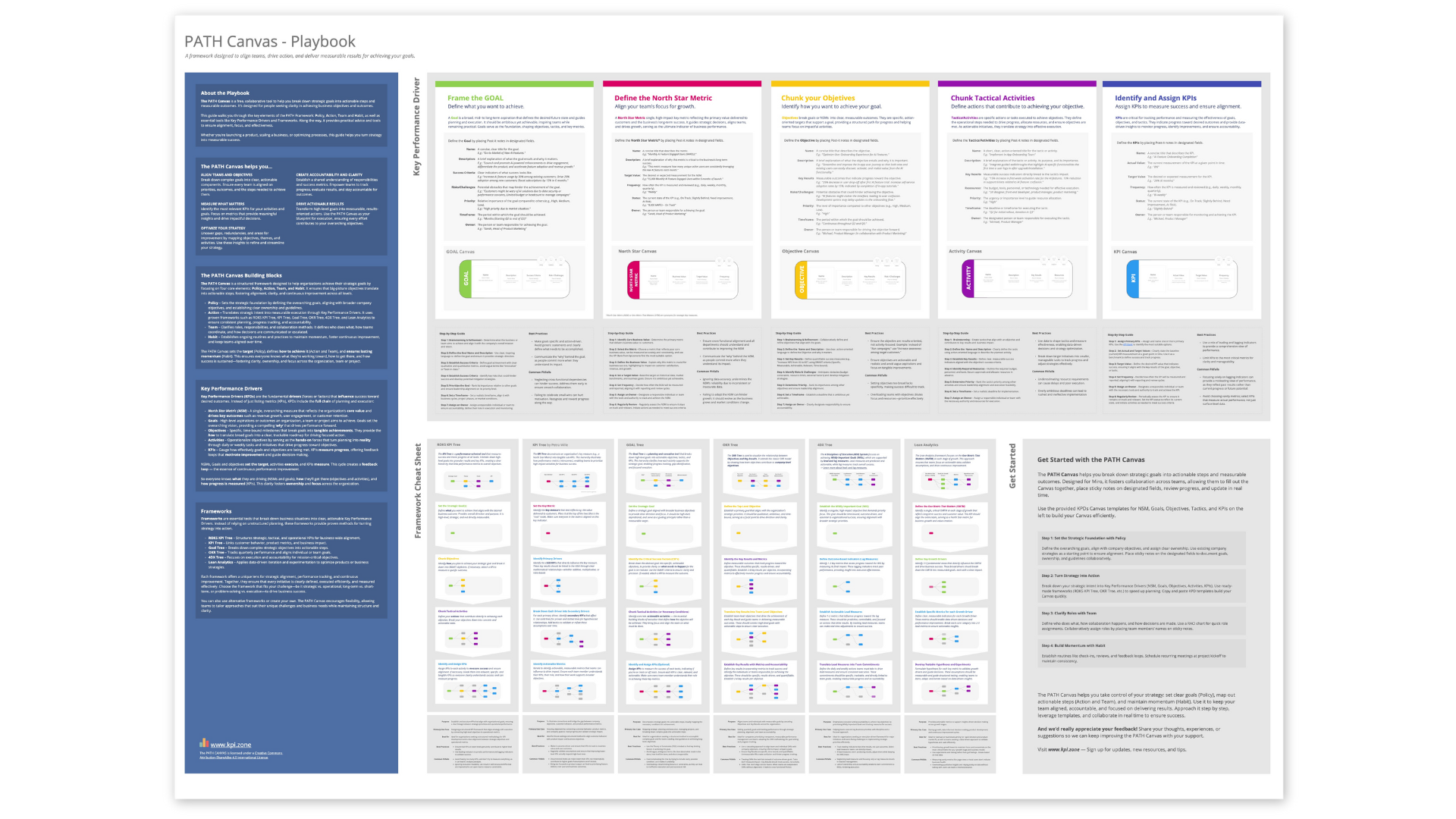
The playbook provides step-by-step guides for each framework:
- When to use ROKS KPI Tree vs OKR Tree vs Goal Tree
- How to fill out each KPD card (North Star Metric, Goal, Objective, Activity, KPI)
- Best practices for each framework
- Common pitfalls to avoid
- Decision guides for framework selection
Teams learn the system once, then apply it consistently. A new team member joining Marketing can immediately understand Product's OKR Tree because they're both built using the same design system. The learning transfers.
Flexibility Within Structure
Six months ago, you used Lean Analytics to validate a new product—focusing on your One Metric That Matters, running experiments, testing hypotheses.
Today, you're scaling that product across the organization. Switch to ROKS KPI Tree to align strategic, tactical, and operational metrics across all departments.
Next quarter, you're executing a critical initiative with a hard deadline. Apply 4DX Tree for execution accountability through lead measures (predictive actions you control) and lag measures (outcomes you're driving).
The Policy, Team, and Habit quadrants stay consistent. The building blocks (North Star Metric, Goals, Objectives, Activities, KPIs) remain the same. Only the framework in the Action quadrant changes to fit your evolving challenge.
This is how a design system should work—adaptable to different use cases while maintaining consistency and compatibility.
Getting Started
PATH Canvas is built for Miro as a collaborative workspace. Here's how to start:
Step 1: Set Your Policy
Open the Policy quadrant. Fill out: Strategic Goal, Owner, Alignment with company objectives, Guidelines and constraints. Use sticky notes on designated fields. This establishes your strategic foundation.
Step 2: Choose Your Framework
In the Action quadrant, select from six framework options. Breaking down a complex initiative? Choose Goal Tree. The canvas loads the Goal Tree template with pre-built KPD card templates.
Step 3: Build Your KPI System
Start with your North Star Metric card. Fill in: Name (e.g., "Monthly AI Feature Engaged Users"), Description (why this matters), Target Value (15,000 users), Frequency (weekly tracking), Owner (Sarah).
Add Goal cards below. Each has fields for: Name, Description, Success Criteria, Risks/Challenges, Priority, Timeframe, Owner.
Add Objective cards below Goals. Each has fields for: Name, Description, Key Results, Risks/Challenges, Priority, Timeframe, Owner.
Add Activity cards below Objectives. Each has fields for: Name, Description, Key Results, Resources, Priority, Timeframe, Owner.
Attach KPI cards to measure progress. Each has fields for: Name, Actual Value, Target Value, Frequency, Status, Owner.
Connect cards visually. Draw lines showing causal relationships—how activities drive objectives, objectives drive goals, goals drive the North Star Metric.
Step 4: Assign Your Team
In the Team quadrant, use the RACI template. For each objective and activity, identify who's Responsible, Accountable, Consulted, Informed. Define collaboration methods and escalation paths.
Step 5: Establish Your Habits
In the Habit quadrant, schedule recurring reviews:
- Daily/Weekly: What KPIs need checking? What blockers need clearing?
- Bi-weekly: Are activities moving objectives?
- Monthly: Are objectives driving goals?
- Quarterly: Do goals still align with the North Star Metric?
The team fills out the canvas together, reviews progress together, updates in real time. The visual board keeps everyone aligned.
The Bottom Line
Teams don't fail at strategy because they lack good frameworks. They fail because every team learns a different framework, uses different terminology, and builds incompatible systems.
PATH Canvas is a design system for KPIs—a shared blueprint that teaches teams how to build measurement systems the same way, using the same components, following the same structure.
When everyone learns the same design system, their work becomes compatible. Systems can connect. Teams can collaborate. Leadership can see the full picture.
Everyone knows what they're driving (North Star Metrics and goals), how they'll get there (objectives and activities), and how progress is measured (KPIs). This clarity creates ownership and focus across the organization.
PATH Canvas is free and open-source under Creative Commons Attribution-ShareAlike 4.0. It includes:
- Six framework templates (ROKS KPI Tree, KPI Tree, Goal Tree, OKR Tree, 4DX Tree, Lean Analytics)
- KPD building block cards (North Star Metric, Goal, Objective, Activity, KPI)
- Step-by-step guides for each framework
- Best practices and common pitfalls
- Framework selection decision guides
- Collaborative Miro workspace
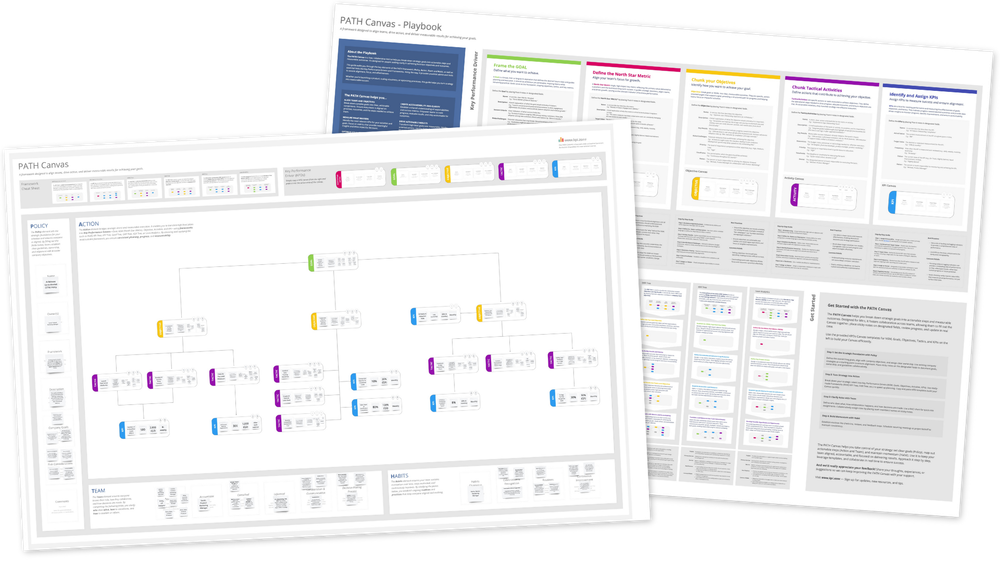
The PATH Canvas
Teams build KPI systems that can't connect because they're using different frameworks and terminology. PATH fixes this— a design system for building compatible KPI frameworks using shared components and structure.
Written by

Subscribe to my newsletter
Subscribe to my newsletter to get the latest updates and news